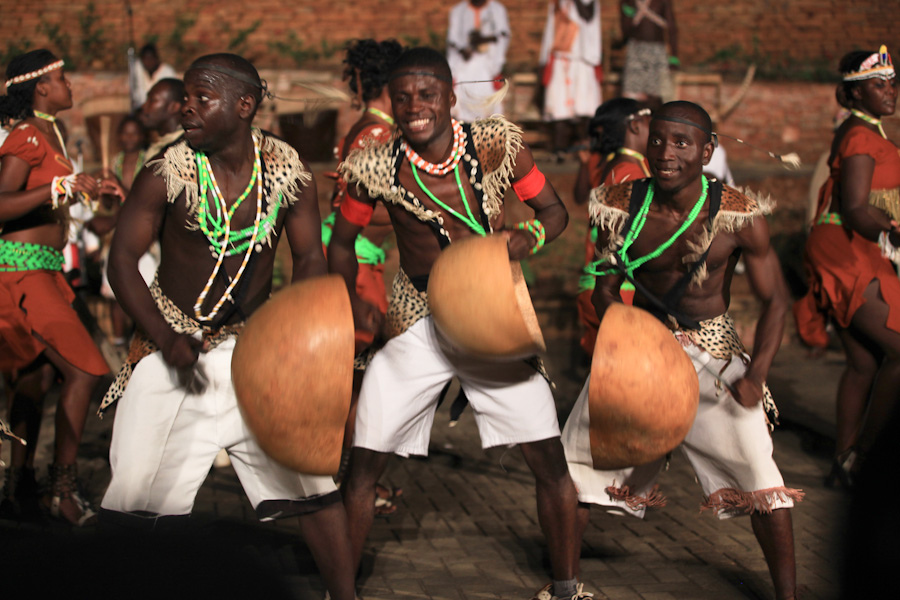
The
insurgency in Northern Uganda that lasted for mpre than 15 years played havoc with the Acholi people and their dances
almost in equal measure. Like any other experiences of armed conflicts, the
war in northern Uganda was bound to cause dislocations in the structure, practice,
sensibilities, procedures, sentimentalities, and essence of traditional dance forms. The artistic and cultural dislocations were compounded by forced migration that communities endured
throughout the entire period of the conflict. This migration took different
forms: home to bush (for people that were abducted by the rebels); home to camp
(especially internally displaced camps); and home to other place (which saw migration
of the Acholi people to other parts of Uganda and beyond).
The story of the migration of dances and dancers from Acholi sub region to Kampala is akin to the legend that explains the genesis of Acholi tribe of northern Uganda and Alur tribe on north western Uganda: both ethnicities were born out of conflict in which blood was spilled. In the case of Acholi and Alur communities, legend has it that Nyipir and Nyabong, both brothers, had a tiff over a spear and a bead. Nyipir took Nyabong’s spear to hunt. He hit the elephant with the spear and it ran away with it. When he returned home, his brother Nyabong insisted on getting back his spear. Nyipir went back and trailed the elephant until he recovered the spear. This experience was so painful for him. Shortly after his return, Nyabong’s daughter swallowed Nyipir’s bead. Nyipir demanded to have his bead back. Nyabong painfully accepted that his daughter be cut to recover the bead. The girl was cut and the bead was recovered. It is this spilling of blood that caused an irreconcilable squabble between the two brothers. They parted ways, never to see each other again. Nyipir wandered and crossed river Nile at Pakwach. He settled in West Nile area and gave birth to the current Alur tribe. Labong stayed on one side of the river and his family expanded to form the current Acholi tribe.
It
is as if the migration of Acholi dances to Kampala was an incarnation of the
Nyipir and Nyabong separation. It is worth noting that the migration of these
dances took dual trajectories: the Watmone (derived from Watmone dancing troupe) and Ndere (derived from Ndere troupe) trajectory. These
two experiences are going to be the focus of this essay.
Quite significantly, the two trajectories, like the Nyipir and Nyabong
separation, were born as a result of conflict (Acholi
insurgency), where blood of thousands of Acholi people was spilled. We can
conclude that these related trajectories came from the womb of human blood.
What is more, both the Nyipir-Nyabong separation and Acholi-to-Kampala
migration of dances involved crossing river Nile, the former at Pakwach and the
latter at Karuma. As Nyipir-Nyabong split gave birth to two formidable ethnic
groups that are still flourishing, migration
of Acholi dances to Southern Uganda has has supported two dance troupes that have prospered in Kampala.
Let
us now track the migration of the Acholi dance trajectories. As I earlier
noted, the exodus of Acholi dances to other parts of Uganda owes a good deal to
the northern insurgency that lasted for more than 15 years. Normally, when
conflicts emerge, people in the affected communities migrate. Some people
migrates with their physical belongings, others do not. However, one commonality between those who
migrate with their physical belongings and those who do not is that they both
migrate with some of their cultural practices. They both migrate with their cultural belongings. Music and dance is one of these cultural belongings.
The Watmone path had Acholi people migrate to Kampala to form a dance troupe under the stewardship of Matthew Watmon. As Watmon notes: “When the war intensified, I decided to come and settle in Kampala from where Iformed a dancing troupe…” The Watmone route was more about the Acholi people migrating with their artistry and figuring out how to situate it and make it relevant and survive in the new environment in Kampala. The troupe set out to focus on dances from the Acholi sub-region. The Ndere trajectory presented a different dynamic. Ndere troupe was already established as early as 1988 as a performing group with a national outlook and character. When the conflict escalated, Ndere started to co-opt both dancers and dances from Acholi region to form the repertory of the troupe. The inclusion of Acholi artistry into Ndere troupe leaned towards expropriation of dances from Acholi region and appropriating them in Kampala. If these two ajectories have managed to survive in 'exile' (Kampala), what dynamic underpins their identity? What strategies have the two troupes taken to have dance artistry from Acholi region flourish? It is to the differences in strategy and experiences between these two troupes that we now turn.
A clear analysis reveals that the Watmone experience has been insulatory in every sense of the word while the Ndere trajectory is expansionist in nature and intent.
The Watmone path had Acholi people migrate to Kampala to form a dance troupe under the stewardship of Matthew Watmon. As Watmon notes: “When the war intensified, I decided to come and settle in Kampala from where Iformed a dancing troupe…” The Watmone route was more about the Acholi people migrating with their artistry and figuring out how to situate it and make it relevant and survive in the new environment in Kampala. The troupe set out to focus on dances from the Acholi sub-region. The Ndere trajectory presented a different dynamic. Ndere troupe was already established as early as 1988 as a performing group with a national outlook and character. When the conflict escalated, Ndere started to co-opt both dancers and dances from Acholi region to form the repertory of the troupe. The inclusion of Acholi artistry into Ndere troupe leaned towards expropriation of dances from Acholi region and appropriating them in Kampala. If these two ajectories have managed to survive in 'exile' (Kampala), what dynamic underpins their identity? What strategies have the two troupes taken to have dance artistry from Acholi region flourish? It is to the differences in strategy and experiences between these two troupes that we now turn.
A clear analysis reveals that the Watmone experience has been insulatory in every sense of the word while the Ndere trajectory is expansionist in nature and intent.
The
Watmone experience has always been insulatory, and is anchored in self-preservation.
This is born out of internal cultural consciousness. The Acholi dances performed by Watmone arrived in Kampala as a victim seeking asylum. Although the new
environment has tampered with some aspects of their performance, Watmone dance
performances are true to the aesthetic and cultural sensibilities, complexities,
simplicities, and polities of dances from Acholi region. Until now, they have
specialized in performing dances from Acholi region. They have striven to
remain true to the Acholi artistic ethic. Their target audience has always been
people from Northern Uganda, although they have expanded to serve both other
national and international populations. Like Jews who have been able to retain,
practice, and cherish their culture in exile, Watmone have succeeded in
insulating their Acholi artistic practices against any excessive external
influences and excesses that come with living in the new environment. Watmone
has succeeded in striking a balance between art for wo/man’s sake and
art for money’s sake. Commercialization has not significantly diluted the true
ethos of Acholi dance aesthetic that the group is committed to preserve,
present, and represent. The dancers understand the artistry, aesthetic,
semiotics, and anthropology of the dances. Watmone has once again proved that
traditional dances can migrate and still retain their true character and form. The group has relied on the commercial to reinforce self and cultural preservation. The songs, instrumentation, technique, and in some cases costume represent the true nature of Acholi dance artistry. The troupe has continued to embrace ethnic singularity, glorify artistic endogamousity, and cultural exclusivity.
 |
| Watmone performers playing Acholi music |
If the Watmone course is insulatory, how
expansionist is the Ndere trajectory? I earlier mentioned that right from the
onset, Ndere troupe exuded national character and outlook in terms of its
artistic repertory and ethnic originality of performers. The repertory ranged from
traditional dances of tribes in Western, Northern, Eastern, and Central Uganda,
although their foundation has always been dances from Western and South Western
Uganda. As such, appropriation of Acholi dances was meant to enrich the
national abundance of the troupe. It was another ethno-artistic dish added to the national
artistic buffet of the troupe. Acholi dances arrived in Ndere as a refugee seeking not only survival but also expansion. The primary objective of the group was not to preserve dances from Acholi. Rather, the goal was to have representation of Acholi artistry in the national artistic umbrella. But
this does not tell the whole story, neither does it paint a complete
expansionist picture. Expansionism is best reflected in the nature of
performers in the troupe. Whereas Watmone is primary constituted of dancers
from Acholi, Ndere has dancers from various ethnicities in Uganda. These dancers were
able to learn and perform dances from Acholi even though they do not come from
this ethnic community. Consequently, these dances were able to cross
demographic and ethnic boundaries. The Ndere experience has always celebrated national plurality, glorified artistic promiscuity, and valued aesthetic exogamousity.
We
cannot talk about expansionism and ignore the artistic and aesthetic
alternations that Ndere have inflicted on the dances from Acholi. Art bows to
change in the face of money and commerce. Commercialization unlocks artistic
and cultural rigidity. Once art becomes a for-money activity, trade patterns
and commerce imprison it. It clings to and swings on the rules of demand and supply. As a
commercial dance troupe, Ndere has altered a number of elements of Acholi
dances such as costume, accompaniment, makeup, etc to appeal to the interests of the clients. There has been expansion in
the internal taxonomy of the dances (how and why dances are performed), for good or worse.
 |
| Ndere troupe performing Larakaraka dance from Acholi. The costume is colorful enough to attract the eye and the sound is amplified to sink in the ears of the audience. |
How
about target audience? Is this expansionism reflected in the audience targeted?
The answer to the preceding question seems to be in the positive. The audience
has a good deal to answer for for this expansionism. The audience for Ndere is
very diverse. Unlike Watmone, which primarily target communities from the
greater north who live in Kampala, Ndere troupe’s audience covers a wide range
of ethnic fabric and geographical space. The troupe has performed in a number
of international events, too.
Nowhere
has this expansionist approach manifested itself than in breakaway troupes that
have seceded from Ndere troupe. Ndere is a womb that has given birth to a number of troupes in Uganda.
Formers performers of the troupe have gone ahead to form their own independent
troupe. In doing this, they have expanded the artistic legacy and philosophy of
Ndere troupe, which included performance of dances from Acholi sub region. What
is more, Ndere troupe sends out its performers to train students in schools that perform in
school-based, regional, and national dance festivals and competitions. In some
instances, these performers have taught Acholi dances the way they learned then in the
troupe. This is yet another expansionist branch.
In
this essay, we have noted that the migration of dances from Acholi to Kampala
took two major dual trajectories: the Watmone trajectory and the Ndere
trajectory. These two trajectories owe a good deal to the initial brotherly
split between Nyipir and Nyabong. Like the legend of Nyipir and Nyabong, the
Acholi dances migrated to the south as a result of conflict where blood was
spilled. Both Nyipir-Nyabong and the migration of Acholi dances to the south
involved crossing of river Nile. The former
at Pakwach,
and the latter at Karuma. The
dual trails of the migration Acholi dances down South have continued to
flourish. The Watmone trajectory is much more insulatory, sensitive to Acholi
cultural sensibilities, and true to the artistic aesthetic. It is anchored in ethnic singularity. The Ndere
trajectory is much more expansionist and inter/nationalistic. It derives its trues identity from national plurality. This expansionism has manifested itself in
the way the dances have been structurally, aesthetically, taxonomically, and
semiotically altered to conform to the market forces of demand and supply.
Furthermore, Ndere has spread Acholi dances to diverse ethnic population
through performances, training, and mothering of other dance troupes.
Alfdaniels Mabingo is a Fulbright fellow at New York University