Showing posts with label education. Show all posts

Thursday, July 25, 2013

Is Africa's Academy African Enough?

Formal education was introduced to Africa with the advent of European colonialism. The purported objective was to build capacity, advance skills and competencies, and widen the knowledge base of native Africans to enable them adeptly partake in and own development processes in their communities. During the colonial period, education focus was put on governance and administration, education, theology, medicine, law, agricultures, and technical education as the key pillars of development.

Years after independence, this Eurocentric education paradigm has not changed much.  The content (what is taught) and pedagogy (how students are taught) has remained the same - Western. Attempts to to de-colonize the African academy are yet to yield recognizable results. Ali A. Mazrui, captures this well by when he posits thus: “Western influence is expressed through another African institution— the university. The university is an analogue to a multinational corporation: born as an extension of a metropolitan university whose direction and instructions come from a European country, the African university continues to serve other than African interests. African educational institutions help produce Westernized or semi-Westernized manpower for the commercial firms and Western values and tastes, thus expanding a culturally-relevant market for Western goods.” The situation that Mazrui alludes to is also detectable at pre-primary, primary, secondary and other tertiary levels of education.  

The school has remained alien to the indigenous African experience. I remember facing this dilemma when I was attending school in rural Uganda. What I was taught at school was remotely linked to the daily experiences that I interacted with at home and in my community. The school curriculum never encompassed local music, dances, folklore, theology, cultural and social values, technology, games and sports, oral literature, history, language, art, and practical skills of production in areas such as agriculture, cottage industries, mining, etc. Instead, emphasis was laid on Western history, theology, geography, civilization, politics, and economics, to mention but the most obvious. Sadly, the curriculum is still the same.

Students attending a class in one of the schools in Uganda
One of the key areas in which the African academy is clearly delinked from the native knowledge bases and structures is the languages used as medium if communication. The medium of information delivery in schools in Francophone and Anglophone countries is French and English, respectively. One might argue that application of these languages has facilitated the integration of the African academy in the global education system, but as Ngugi Wa Thiogo has noted, ‘we (African people) still collect intellectual items and put them in European language museums and archives and people have to dig into those languages in order to access knowledge about ourselves. Our knowledge of Africa is largely filtered through European languages and their vocabulary. Is it not time that our scholarship stopped finding legitimacy in European languages…?’ This intellectual enslavement through languages and other forms has undermined capacity by native people to develop local knowledge. 
Suffice it to note that the process of learning leads to a process of unlearning.  Since language influences interpretation, generation, dissection, development, survival, dissemination and application of knowledge, the western paradigm of education (that centers around western content, pedagogy, and languages) on which the African academy is founded has disengaged the African teacher, student, scholar, academic, and researcher from the African realities. To this end, African knowledge, actualities, and experiences are lost in translation as a result of learning and teaching through the lens of European education and literary prototype.
Consequently, the African education system has produced graduates who cannot suitably serve in their own social, cultural, political and economic environments and contexts. This alienation of the African graduate from his/her local existential realities has rendered western formal education less effective in terms of generating relevant human resources to solve local challenges.

Developing local knowledge will increase Africa’s comparative advantage in the global market. This can only be achieved if there is change in the education criteria, introduce narratives that will exude the indigenous experience and knowledge structures and mechanisms, and stimulate locally oriented productivity. This shift should begin with Africans reclaiming confidence in their own indigenous knowledge and its ability to transform their lives locally.

This tale should prompt a shift in intellectual thinking, and education paradigm and approach. New pedagogic models need to be developed to facilitate a process that would equip graduates with skills, knowledge and competences that are responsive to local conditions and needs. The African academy is yearning for African identity; it needs to be de-Europeanized. Stakeholders such as teachers, policy makers, civil society organizations, local leaders, education administrators, school inspectors, students and curriculum developers need to engage in discourses to identify and draw a roadmap aimed at indigenization process of the academy. This paradigm shift in education system will render formal education much more relevant to the local realities, environment, needs and conditions.

Tuesday, August 28, 2012

Does Indigenous Training of Ethnic Dances in African Cultures Follow any Inherent Pedagogy?


In February of this year, I was invited to present a paper entitled: “Different Paths, same Destination: Comparison between Indigenous Ugandan Communal-based Dance Pedagogy and Formal/Western Dance Education Pedagogy” during the Dance across the Board conference organized by Tisch School of the Arts, New York University. My presentation dwelled on convergences and divergences between indigenous dance pedagogy in Ugandan cultures and formal/western dance pedagogy. This article is an abridged version of my paper, with specific accent on the pedagogy underlying training of traditional dances in native cultures in Africa.

Dances in cultures in Africa have existed and survived even without archival documentation and Western formal education. Communities in Africa relied on oral tradition as a form of information dissemination and documentation. Suffice it to note that dance is yet to be fully incorporated in the education curriculum in most parts of Africa, and that formal education has not abundantly permeated the geographical fabric of the continent. As such, the thread that has supported the survival and existence of dances even after the advent of colonialism and Christianity in Africa is their strong embodiment of culture and attachment to people. How are communities able to pass on dance skills and knowledge in the absence formal/western education systems? Does absence of western/formal dance education systems in indigenous communities mean nonexistence of dance pedagogy?

Unquestionably, training of dances in cultures in Africa is based on an inherent and set pedagogy, albeit undocumented. Indigenous pedagogy is one of the components that serve and feed the knowledge and value systems that dances are preordained to sustain, enrich, support, and test. Indigenous pedagogy is in tandem with the procedures, ethics, standards, frameworks, policies, practices, values, and the overall philosophy of a people. To deconstruct the pedagogy underlying teaching of dances in African cultures, I will proceed to discuss the training systems, teachers and learners, learning environment and management of training, school and classroom, content delivered and  methods of delivery, teaching and learning aids, evaluation and provision of feedback.

Education/training system
Training of dances in cultures in Africa is based on a set system. The taxonomy of this system starts before a child is born and develops after their demise. Before a child is born, s/he is introduced to rhythm and movement through songs and dances that the mother is subjected to as part of indigenous antenatal care and treatment. The child is exposed to dance and music by extension. The same child is introduced to music as a toddler, child, adolescent, young adult, adult and ancestor (after his/her death). Dance facilitates progressive graduation of a human being at each stage of growth and development. At each stage of human growth there is a set of dances that a person is exposed to.  As such, we can conclude that the indigenous dance teaching and learning system covers pre-birth, post birth, toddlerhood, childhood, post-childhood/’adolescenthood’, adulthood and post-adulthood grades/stages of education. Indigenous dance training follows a clearly laid out chronological and ascending system.

The teacher and learner
The concepts of a teacher and leaner are communally shared and embraced. At any occasion of learning or performing dance, the participants double as teachers and learners. There is a tendency to learn from and teach one another. The communal identity and spirit that is inherent in dances from cultures in Africa is, to a very large extent, a byproduct of individual identities that congregate to form the collective. The shared responsibility of teaching and learning is meant to encourage collective ownership of the dances learned. It also persuades continual metamorphosis and purification of the dances by tapping into the diverse wealth of dance competencies, skills and knowledge that different people posses. Dance is a result of communal consensus between different individuals who contribute to its creation and teaching.

Learning environment and management of learning and teaching
The learning environment is porous and all inclusive, particularly for dances that are not gender, age, sub-lineage or clan specific. But even with dances that are specific to particular populations, there is litheness for entitled persons to play a part. The erudition atmosphere provides room for participants to project their individuality through improvisation, and to learn from one another. Commonly, communal performance, teaching and learning of dance happen simultaneously. The teaching and learning philosophy that is ardently followed is: “do as you learn, and learn as you do.” This philosophy is inspirational in style and transformational in objective. In some instances, the most experienced members of the community “provide leadership” in the teaching, learning and performance processes. I have put provide leadership in inverted commas because these master performers do not impose content on the participants. Rather, they provide support basing on what the learners already know and have. In this context, respect for one another and discipline are highly encouraged.

The school, classroom and studio
The theory of a school and classroom existed before the introduction of western education in Africa. The home and community acted as a school, with the fireplace acting as a classroom. This framework is still alive in communities that have not been fully permeated by western education influence. Open community spaces accommodate communal based performances, which double as teaching and learning avenues. Any available space, whether enclosed or open, is studio space. Participation in the performance, learning and teaching processes is open to all members of the community. In most communities, there is a communally set schedule/timetable for exploration of dance and music performances. Before graduation to a level of community performance, the home acts as a nursery or kindergarten that prepares the person for wider communal experiences - community performances. At this level, the fire place, which is common in extended families, act as the classroom. Therefore, an individual receives orientation into music and dance traditions before they venture out to interact with communities outside their home. Normally, the elders act as guides, mentors, academic advisors, counselors in the process of orienting the young ones into dance practices. Beyond movements, the elders take learners through theories, philosophies, dogmas, procedures, ethics, and ideologies that underpin these music and dance traditions.

Dance content and methods of content delivery
If dance is a microcosm of cultural experiences, where is its content derived? Is this content static (does not change)? Who determines the content to be accepted and ignored in the teaching and learning process? How is this content delivered? At an individual level, the communal process that culminates into dance involves getting compromised by and compromising with fellow participants. As I already mentioned, individuals import their individuality, competencies, creativity, artistic acumen into the learning and teaching experiences.

The performance, learning and teaching venues becomes a bee-hive of dance diversities and activities. This marks the beginning of communal negotiation where different individuals personify movements and techniques that they consider attractive from fellow participants, and ignore those that they deem repellent.  Individuals derive content from their day-to-day experiences that relate and conform to the practices of the community For example, hunters draw from their hunting experiences to inform hunting dances; warriors draw from war experiences to create, teach and learn war dances; agriculturalist borrow from their agricultural lifestyle and experiences to advance harvest dances, etc. The content is communally constituted and so are the methods of delivery. This reciprocal (give and take) approach is so anchored in the participants’ mindset that you cannot have any individual claiming choreography or invention of any indigenous dance techniques. The more a community engages in performance of the dance, the more individuals refine and get familiar with the dance in question.

Before individuals engage in any teaching and learning of dance, they engage in warm up. The way this warm up is applied is different from the ‘warm up’ as it is known in formal/western dance education. The indigenous warm up for dance participants in African cultures is not structured. Because people have to walk and run for long distances to participate in communal dance bonanzas, their bodies are warm by the time they reach the venue of the dance feat, and are ready to dance without any delay.

Teaching and learning aids
Learning and teaching dance is a reminder and reflection of the lived experiences that related to the cultural viewpoint o which the dance is based. In a purely typical indigenous setting, teaching and learning of dance stretches beyond going through movement routines. It is about engraining and cultivating experiences that relay the anthropological, cultural, social, theological, demographic, economic, political, and sociological foundation of the community. It logically follows that the experiences act as learning and teaching aid in this array. Unlike formal dance studios where the mirror is used as a teaching aid, in indigenous dance training the mirror does not exist but mirroring subsists. The learner depends on fellow learners/teachers and the existing performance, teaching and learning experience as the mirror. The experiences stimulate the psyche whereas emulation of other participants smoothes the progress of kinesthetic intelligence and precision. It is worth noting that inter and intra-personal mirroring augments communalism.

Music, whether vocal, instrumental or both is a teaching and learning aid in indigenous dance training in cultures in Africa. Beyond providing accompaniment, music provides the narrative and rhythmic composition that dances personifies. Dance is an extension of music; music facilitates teaching and learning of dance. To this end, competence in music comprehension and how this relates to a dance is fundamental in facilitating the learning and teaching of that given dance.

Evaluation and provision of feedback
Evaluation and provision of feedback in this teaching and learning process is continuous. Peer assessment and collective feedback is common. The performers, who double as teachers and learner encourage and assist each other. Grownups guide young-ones while young-ones help each other especially in children dances. Particularly noteworthy is that for initiation/rite of passage dances and royal dances, the dance masters in a given community monitor the performance of candidates to identify those who are ready for initiation rituals and to perform in the courts respectively. For courtship/moonlight dances, the participating candidates evaluate each other to identify a suitable partner.

Assessment and feedback is meant to invite an individual to a place where they can fittingly contribute to the framing of the group/communal identity. This is well exemplified by the ethnic philosophy of the Luba people of Congo that “I am because we are, and we are because I am.” Native African communities know that without individuals communities cannot stand and without a community an individual cannot survive. This same mentality is captured in the training and performance of indigenous dance.

To wrap up this missive, I assert that training of dances in indigenous communities in Africa is premised in a well articulated and set out pedagogy that covers the teaching and learning philosophy, the teacher and learner, the school, classroom and studio, dance content and methods of content delivery, among others.

Tuesday, June 26, 2012

Theorizing ‘Africanness’: Why ‘African Dance’ is not ‘African Dance’


What has baffled me most throughout my academic and professional career is the concept “African Dance.” In a world in which almost everything is framed in the idiom of the market, the concept ‘African Dance’ has proven particularly compelling. Widely used by academic institutions, arts organisations, dance companies and troupes, scholars, teachers, performers, and a wide range of arts practitioners, this concept is still craving for a comprehensively laid out explanation. In an attempt to find an accurate rationalization of what is and what is not ‘African Dance’, I have bounced the question: ‘What is African about ‘African Dance’?’ to a range of people, including continental Africans.

The answers that I have received in response to the above question are as varied as the people that I have consulted. In fact, the responses have raised more questions than answers. A number of these responses are just a regurgitation of what some scholars have posited as “characteristics of ‘African Dance’” – use of the drum, circular formation, poly-rhythmic, orientated towards the earth, improvisation, isolation of body parts, etc.

This lack of explanatory intelligibility makes the concept ‘African Dance’ resemble the biblical tower of Babel, which builders failed to complete because they started speaking different languages-tongues.

The questions that arise from this conceptual ambiguity are: Why is the concept ‘African Dance’ a mystification? If the concept ‘African Dance’ is too succinct, how deep is its impact?

It appears the coining of this concept was based on the assumption of universalism of knowledge and cultural practices in Africa. Theorization of dance and music practices from cultures in Africa was anchored in the sense of “’horizontal fraternity’, itself imaginatively embedded in fiction of cultural homogeneity” (J.L. Comaroff & J. Comaroff, 2009). Artistic relativism and ethnic heterogeneity was disregarded. Yet, Africa as a continent is a collection of heterogeneous demographics, and not a homogeneous entity. It is estimated that Africa is composed of more than 3000 tribal and sub-tribal communities, with each tribe boasting of a range of cultural practices that are poles apart.

The miscellany of ethnicities and sub-ethnicities translates into multiplicities of music and dance traditions that are distinct from one another and unique to these particular communities. As Judith Lynne Hanna appositely attests, “Africa has about 1000 different languages and probably as many dance patterns. Dance styles vary enormously and so do definitions of dance. For example, among the Ibo, Akan, Efik, Azande, and Kamba, dance involves vocal and instrumental music, including the drum, whereas among the Zulu, Matabele, Shi, Ngoni, Turkana, and Wanyaturu, drums are not used, and sometimes the users of drums are despised.” Therefore, to clamp these culturally diverse dance forms into one umbrella – ‘African Dance’, was bound to create ontological, epistemological, axiological and etymological challenges in the study and practice of dance forms from cultures in Africa. 

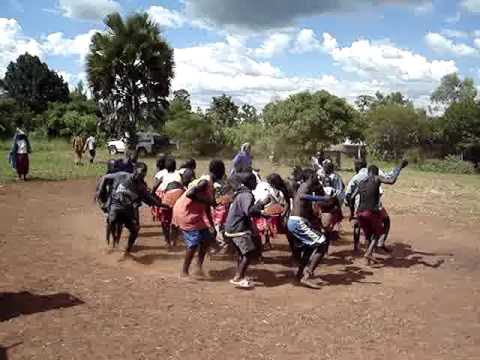
 Karimojong people of North Eastern Uganda performing one of the traditional dances. The drum is not common in dances of the Karamojong people.

The notion that ‘African Dance’ is ‘African Dance’ was exacerbated by the actuality that most of Africa’s pre-colonial, colonial and post-colonial cultural history was written and documented by habitually non-Africans. And frequently, early European observers of African behavior did not consider African dance to be dance, for it was not the familiar classical ballet or foot-tapping folk dance of their home countries (Hanna, 1973). This history cannot be wished away for it forms and informs the current academic, literary and artistic discourses and trajectories.  Whereas writing about cultural history might seem to be mere chronicling of events, circumstance, experiences, stories and instances, the interpretation and consumption of ethno-commodities by the writer (consumer), and its conversion into literary work is as imperative. In the process of writing, these commodities are re-processed, re/mis/interpreted, and misrepresented. In this instance, theorization of vernacular dance forms from cultures in Africa suffered latent and manifest orientalism, which gave birth to contemporary artistic orientalism.      

The first researchers, writers and teachers of dances from cultures in Africa were mostly Europeans and North Americans. Moreover, they were anthropologists, ethnomusicologists and sociologists – not dancers. According to Mazrui (2002), our understanding of Africa and its past has been bedeviled by reports written by imaginative European travelers throughout the continent. Predictably, their analysis, conceptualization and interpretation of cultural identities in Africa was more ‘Americentric’ and Eurocentric than ‘Afrocentric’. Not even their ethnographic approaches to scientific and non-scientific discovery could deliver clarity and details encompassed in dance practices from cultures in Africa! In many ways, the recollection of past events, passed on by word of mouth in Africa today, may be a better guide than the vivid and romantic accounts of some of the European explorers (Mazrui, 2002).

In this Western-oriented literary trajectory, the content generated about dances from Africa fell prey of a noteworthy scale of confirmation, intellectual and cultural bias; and the ensuing knowledge de-Africanized. Cognizant of the fact that “Africans are a people of the day before yesterday and the day after tomorrow" (Mazrui, 1986), what must concern us is the history of the present. Or, more specifically, its effects: how is it alternating the comportment in which artistry, scholarship and teaching of dances from cultures in Africa is experienced, philosophized, conceptualized, re-theorized, comprehended, ratified, and represented.  

‘African Dance’ is just an imagined concept. It is a sheer geographical expression than a representation of multicultural existentialities and artistic, creative and aesthetic dualities that are replicated in the diverse dance and music traditions. Max Beloff reminds us that 'it is easier to understand the contiguities of geography than continuities of history.' The generalization of African dances has ensconced a subterranean and stereotypical fallacy that Africa is not a continent with mottled demographics but a single identical entity. If we are convinced that the concept ‘African Dance’ is valid, why don’t we have ‘European dance’ or ‘American Dance’ or ‘Asian Dance’ as styles of dance?

The concept ‘African Dance’ is begging for lucidity. Revisiting this notion is logical, and redefining it most apt.  It is our duty as teachers, researchers, trainers, scholars, performers and instructors of “Dances from Cultures in Africa” (emphasis) to unravel this historical distortion, deconstruct this nebulous concept and the mindset that it has fashioned.   

Modifying the concept ‘African Dance’ to ‘Dances from Cultures in Africa’ can be a good starting point in providing this long awaited clarity, which will assist  these art forms to claim their rightful place in modern and global civilization.

Alfdaniels Mabingo is a Fulbright Fellow at New York University

Wednesday, June 6, 2012

Serving Beyond the Stage: The Role of the Arts in Community Building in Post War Areas in the Great Lakes Region


In my previous article, I provided an account of the consequences armed conflicts and rebellions have meted out on cultural arts practices in the great lakes region. One of the grave effects is alienation of communities from their cultural history and chronological heritage. A number of interventions have been instituted by governments, civil society organisations, private sector agencies and non-governmental organisations with aim to aid rebuilding and resettlement of communities in post war areas. Focus has been put on education, health, agriculture, and physical infrastructures sectors.  Not enough resources have been invested in the culture sector as a driver that can steer social, political and economic transformation.

Indigenous performing arts act as an encyclopedia of cultural norms, practices, beliefs, values, philosophies, ideologies and theories. Language, dress code, economic practices, theological beliefs, ethno-botany and medicine, and social structures are coalesced in music, dance and drama of a people. Further, the arts are a laboratory in which cultural evolution can be tested or/ and detected. Reclaiming cultural identity is vital in advancing social, psychological, political, and cultural empowerment of the communities that were ravaged by armed conflicts in the great lakes region. This sense of cultural identity cannot be reinstated without active application and utilization of arts.

Whereas communities in war torn regions were distanced away from their indigenous music and dance practices, some arts performance elements were retained in some cases. Additionally, there are knowledgeable individuals that survived the wrath of this armed conflicts. To this end, communities can be supported to utilize the already available knowledge and resources to repossess what the war snatched away from them.  Community based performances, indigenous family apprenticeship in the arts, competitions, festivals and ceremonies that engross the arts should be encouraged within these communities. This will revivify the lost sense of cultural identity, cachet and pride.

Population in the great lakes region is becoming younger. With fertility rate at 6.7% in Uganda, 4.8% in the Democratic Republic of Congo, 6.7% in Southern Sudan, 4.46% in Burundi, and 5.4%in Rwanda, the young population is promising to do all but rise. Cases of young population explosion in post war areas are evident. To this end, it is imperative to design programs tailor-made to facilitate early child development. These communities have music and dances that were composed and created to encourage social, cultural, physical, psychological, and psycho-motor development and empowerment of the child. 

 Children in northern Uganda performing Bwola dance (courtesy photo)

Performing arts can be used to advance creativity, nurture talent, cultivate cultural consciousness, and encourage a sense of communal responsibility among the young population. In addition to providing the education, shelter, health care and food for the child, stakeholders need to encourage and promote integration of arts in programs that target children in post war areas.

From a purely economic standpoint, cultural arts can impart skills and knowledge that youth in post war areas can turn into economic ventures.  Training in music composition and performance, dance choreography and performance, arts documentation and production can advance competence of these communities in the arts. Government and other stakeholders need to develop and implement programs that aim to encourage communities to convert indigenous art forms into commercial products. Follow up mechanisms can be put in place to promote and market artistic works produced by these communities. This will increase the employability and productivity of youth in these communities.

The importance of the arts in fostering lifelong skills is well captured by Charles Onyango Obbo (The Daily Monitor, March 21, 2012) who has noted thus: “The best example for this, in Makerere University at least, is in a place where no one ever looks. It is at what was once, and probably still is, the most despised course at Makerere University – Music, Dance, and Drama (MDD). The most tired and small-minded joke on Makerere Hill for years is that MDD stands for Musiru Dala Dala (he/she is very stupid).  However, MDD is the only course at Makerere that teaches you to be what you learn. You learn to act, and you act. You learn to sing, and you sing.” Communities in post war areas need lifelong skills that will aid localized and grassroots-based productivity and competitiveness at a national, regional and international level.

We cannot talk about revamping the education system for communities in post war areas without creating space for the arts within the mainstream curriculum. Education models developed for different levels of education in these areas need to be hyper local. Indigenous knowledge, which is richly imbedded in the arts and other cultural practices, should form the basis for the broader education sector. The arts should have a place in the curriculum, the classroom, and within community-based education paradigms. 

It is worth noting that performing arts from ethnicities in post war areas carry educational and informative messages and knowledge. Systems within the education sector must be established to tap into this rich resource, encourage cross-cultural awareness, and cultivate intra-cultural consciousness.

Programs developed to resettle people back into villages and communities from internally displaced persons camps (IDPs) need to incorporate the arts for community building, therapeutic purposes, intra-ethnic reconciliation, and cultural receptivity. People should be supported to participate in arts related activities that aim to address pressing issues such as health, education, agriculture, environment, sanitation, reconciliation, among others. The best way to empower these communities is by allowing them to partake and own processes that are set to achieve social, cultural, political and economic transformation.  

The arts can be used as a service in the rebuilding and recovery course in post armed conflict areas. We stand to lose a lot if we stick to the mentality that restricts the arts to the stage.

Alfdaniels Mabingo is a Fulbright Fellow at New York University