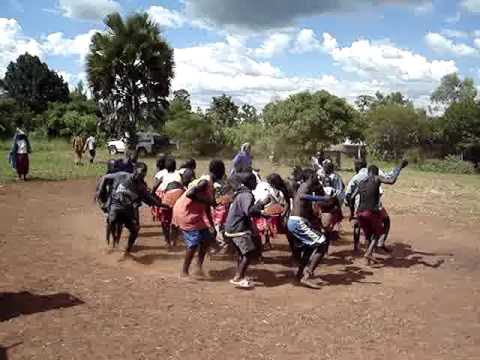
In February of this year, I was invited to present a
paper entitled: “Different Paths, same Destination:
Comparison between Indigenous Ugandan Communal-based Dance
Pedagogy and Formal/Western Dance Education Pedagogy” during the Dance across
the Board conference organized by Tisch School of the Arts, New York
University. My presentation dwelled on convergences and divergences between indigenous
dance pedagogy in Ugandan cultures and formal/western dance pedagogy. This
article is an abridged version of my paper, with specific accent on the
pedagogy underlying training of traditional dances in native cultures in
Africa.
Dances in cultures in Africa have existed and
survived even without archival documentation and Western formal education.
Communities in Africa relied on oral tradition as a form of information
dissemination and documentation. Suffice it to note that dance is yet to be
fully incorporated in the education curriculum in most parts of Africa, and
that formal education has not abundantly permeated the geographical fabric of
the continent. As such, the thread that has supported the survival and
existence of dances even after the advent of colonialism and Christianity in Africa
is their strong embodiment of culture and attachment to people. How are
communities able to pass on dance skills and knowledge in the absence formal/western
education systems? Does absence of western/formal dance education systems in indigenous
communities mean nonexistence of dance pedagogy?
Unquestionably, training of dances in
cultures in Africa is based on an inherent and set pedagogy, albeit
undocumented. Indigenous pedagogy is one of the components that serve and feed
the knowledge and value systems that dances are preordained to sustain, enrich,
support, and test. Indigenous pedagogy is in tandem with the procedures,
ethics, standards, frameworks, policies, practices, values, and the overall
philosophy of a people. To deconstruct the pedagogy underlying teaching of
dances in African cultures, I will proceed to discuss the training systems, teachers
and learners, learning environment and management of training, school and
classroom, content delivered and methods
of delivery, teaching and learning aids, evaluation and provision of feedback.
Education/training
system
Training of dances in cultures in Africa is based
on a set system. The taxonomy of this system starts before a child is born and
develops after their demise. Before a child is born, s/he is introduced to
rhythm and movement through songs and dances that the mother is subjected to as
part of indigenous antenatal care and treatment. The child is exposed to dance
and music by extension. The same child is introduced to music as a toddler,
child, adolescent, young adult, adult and ancestor (after his/her death). Dance
facilitates progressive graduation of a human being at each stage of growth and
development. At each stage of human growth there is a set of dances that a
person is exposed to. As such, we can
conclude that the indigenous dance teaching and learning system covers pre-birth,
post birth, toddlerhood, childhood, post-childhood/’adolescenthood’, adulthood
and post-adulthood grades/stages of education. Indigenous dance training follows a clearly laid out chronological and ascending system.
The teacher
and learner
The concepts of a teacher and leaner are
communally shared and embraced. At any occasion of learning or performing
dance, the participants double as teachers and learners. There is a tendency to
learn from and teach one another. The communal identity and spirit that is
inherent in dances from cultures in Africa is, to a very large extent, a
byproduct of individual identities that congregate to form the collective. The
shared responsibility of teaching and learning is meant to encourage collective
ownership of the dances learned. It also persuades continual metamorphosis and purification
of the dances by tapping into the diverse wealth of dance competencies, skills
and knowledge that different people posses. Dance is a result of communal
consensus between different individuals who contribute to its creation and
teaching.
Learning
environment and management of learning and teaching
The learning environment is porous and all
inclusive, particularly for dances that are not gender, age, sub-lineage or
clan specific. But even with dances that are specific to particular populations,
there is litheness for entitled persons to play a part. The erudition atmosphere
provides room for participants to project their individuality through
improvisation, and to learn from one another. Commonly, communal performance,
teaching and learning of dance happen simultaneously. The teaching and learning
philosophy that is ardently followed is: “do as you learn, and learn as you
do.” This philosophy is inspirational in style and transformational in
objective. In some instances, the most experienced members of the community
“provide leadership” in the teaching, learning and performance processes. I
have put provide leadership in inverted commas because these master performers
do not impose content on the participants. Rather, they provide support basing
on what the learners already know and have. In this context, respect for one
another and discipline are highly encouraged.
The school,
classroom and studio
The theory of a school and classroom existed
before the introduction of western education in Africa. The home and community
acted as a school, with the fireplace acting as a classroom. This framework is
still alive in communities that have not been fully permeated by western
education influence. Open community spaces accommodate communal based
performances, which double as teaching and learning avenues. Any available
space, whether enclosed or open, is studio space. Participation in the
performance, learning and teaching processes is open to all members of the
community. In most communities, there is a communally set schedule/timetable
for exploration of dance and music performances. Before graduation to a level
of community performance, the home acts as a nursery or kindergarten that
prepares the person for wider communal experiences - community performances. At
this level, the fire place, which is common in extended families, act as the
classroom. Therefore, an individual receives orientation into music and dance
traditions before they venture out to interact with communities outside their
home. Normally, the elders act as guides, mentors, academic advisors,
counselors in the process of orienting the young ones into dance practices.
Beyond movements, the elders take learners through theories, philosophies,
dogmas, procedures, ethics, and ideologies that underpin these music and dance
traditions.
Dance content
and methods of content delivery
If dance is a microcosm of cultural
experiences, where is its content derived? Is this content static (does not
change)? Who determines the content to be accepted and ignored in the teaching
and learning process? How is this content delivered? At an individual level,
the communal process that culminates into dance involves getting compromised by
and compromising with fellow participants. As I already mentioned, individuals
import their individuality, competencies, creativity, artistic acumen into
the learning and teaching experiences.
The performance, learning and teaching venues
becomes a bee-hive of dance diversities and activities. This marks the
beginning of communal negotiation where different individuals personify movements
and techniques that they consider attractive from fellow participants, and
ignore those that they deem repellent. Individuals
derive content from their day-to-day experiences that relate and conform to the
practices of the community For example, hunters draw from their hunting
experiences to inform hunting dances; warriors draw from war experiences to
create, teach and learn war dances; agriculturalist borrow from their
agricultural lifestyle and experiences to advance harvest dances, etc. The
content is communally constituted and so are the methods of delivery. This
reciprocal (give and take) approach is so anchored in the participants’ mindset
that you cannot have any individual claiming choreography or invention of any
indigenous dance techniques. The more a community engages in performance of the
dance, the more individuals refine and get familiar with the dance in question.
Before individuals engage in any teaching and
learning of dance, they engage in warm up. The way this warm up is applied is
different from the ‘warm up’ as it is known in formal/western dance education.
The indigenous warm up for dance participants in African cultures is not
structured. Because people have to walk and run for long distances to
participate in communal dance bonanzas, their bodies are warm by the time they
reach the venue of the dance feat, and are ready to dance without any delay.
Teaching and
learning aids
Learning and teaching dance is a reminder and
reflection of the lived experiences that related to the cultural viewpoint o which
the dance is based. In a purely typical indigenous setting, teaching and
learning of dance stretches beyond going through movement routines. It is about
engraining and cultivating experiences that relay the anthropological,
cultural, social, theological, demographic, economic, political, and
sociological foundation of the community. It logically follows that the
experiences act as learning and teaching aid in this array. Unlike formal dance
studios where the mirror is used as a teaching aid, in indigenous dance
training the mirror does not exist but mirroring subsists. The learner depends
on fellow learners/teachers and the existing performance, teaching and learning
experience as the mirror. The experiences stimulate the psyche whereas
emulation of other participants smoothes the progress of kinesthetic
intelligence and precision. It is worth noting that inter and intra-personal
mirroring augments communalism.
Music, whether vocal, instrumental or both is
a teaching and learning aid in indigenous dance training in cultures in Africa.
Beyond providing accompaniment, music provides the narrative and rhythmic composition
that dances personifies. Dance is an extension of music; music facilitates
teaching and learning of dance. To this end, competence in music comprehension
and how this relates to a dance is fundamental in facilitating the learning and
teaching of that given dance.
Evaluation
and provision of feedback
Evaluation and provision of feedback in this
teaching and learning process is continuous. Peer assessment and collective
feedback is common. The performers, who double as teachers and learner
encourage and assist each other. Grownups guide young-ones while young-ones
help each other especially in children dances. Particularly noteworthy is that
for initiation/rite of passage dances and royal dances, the dance masters in a
given community monitor the performance of candidates to identify those who are
ready for initiation rituals and to perform in the courts respectively. For
courtship/moonlight dances, the participating candidates evaluate each other to
identify a suitable partner.
Assessment and feedback is meant to invite an
individual to a place where they can fittingly contribute to the framing of the
group/communal identity. This is well exemplified by the ethnic philosophy of
the Luba people of Congo that “I am because we are, and we are because I am.”
Native African communities know that without individuals communities cannot
stand and without a community an individual cannot survive. This same mentality
is captured in the training and performance of indigenous dance.
To wrap up this missive, I assert that
training of dances in indigenous communities in Africa is premised in a well
articulated and set out pedagogy that covers the teaching and learning
philosophy, the teacher and learner, the school, classroom and studio, dance
content and methods of content delivery, among others.